McDonald’s SWOT Analysis

McDonald’s SWOT Analysis

So your professor wants you to perform a SWOT analysis for MacDonald’s.  And you’ve decided the best way to kick off the assignment is to browse around a little. Somehow you found yourself here. This post will conduct a McDonald’s SWOT analysis so you can replicate the process for your assignment. A SWOT analysis is a tool that helps savvy investors and competent executives make strategic business decisions. The process involved is pretty simple. However, it’s not always easy.

What’s a SWOT ANALYSIS?

SWOT is an acronym for Strengths, Weaknesses, Opportunities, and Threats. A  SWOT analysis methodically examines each of these 4 aspects to see if there are any insights hidden therein.

Generally, strengths are factors that enable an entity to seize any opportunities that are up for grabs. Threats, on the other hand, tend to conspire with weaknesses to further complicate things for a business. 

You’ll do well to keep this understanding in mind as we cruise through this MacDonald’s SWOT analysis.  In this process, we’ll spend sufficient time deliberating on each of the 4 aspects mentioned above. Weseek to understand how each aspect strengthens or weakens MacDonald’s.

We’ll discuss each component under a separate subheading so we can give it adequate attention. Another reason we’ll do that is to keep the analysis organized.  Before we embark on the journey, it’s critical toknow what MacDonald’s does.

MacDonald’s: A Brief History and What the Company Does

McDonald’s SWOT Analysis

As Napoleon Hill (1937) so aptly states in Think and Grow rich, adversity carries within itself the seeds of success. No person who follows Hill’s advice — knowingly or unknowingly— ever gives up. Maurice and RichardMacDonald (brothers) had failed in a movie business in New England. But they were not willing to quit. Instead, they relocated to California and founded their very first McDonald restaurant, which was merely a hamburger stand (1940).

Over the years, they labored hard. They also strategized hard. The year 1948 was a defining one in their entrepreneurial journey. In that year, the dynamic duo incorporated the Speedee Service System which featured the “soon to be famous” 15 cents apiece hamburgers. 

The success the brothers saw must have inspired them to introduce franchising into their overall business strategy. As a result, the business grew into 10 restaurants, nine of which were franchises. You can learn more about the company from its official website.

Ray Kroc Appears on the Scene

Before the money and fame, Ray Kroc sold milkshake mixing machines. That’s how he ran into the Macdonald brothers. Kroc possessedgreat salesmanship skills. It’s not hard to figure out why the brothers let him become agent for their franchising business. Kroc would later (1961) acquire the business from the brothers for $2.7 million. The deal’s value was a colossal sum those days.

To organize the business he’d bought, he established a company called McDonald’s System, Inc. The company’s name would later change to present day’s MacDonald’s Corp. Even though the company was founded in California, its headquarters are in West Loop, Chicago. Before 2018, the company’s headquarters sat in Oak Brook, Illinois.

The New Owner’s Vision

It turned out that Kroc had a really huge vision for his new business. Initially, he planned to plant 1,000 restaurants in the United States. But the business ended up expanding into international markets. Canada and Puerto Rico are some of very first new locations McDonald’s grew into in 1967.

Today, the well-known fast-food behemoth owns or controls restaurants in 120+ countries. According to Statista (2018), McDonald’s Corp ownedat least 37,855 restaurants as of 2018.

Currently, franchisees own 92.7 percent of the business, according to Forbes (Feb 4, 2019). Eventually, the company intends to have 95 percent of its business operated by franchisees.  Forbes also says that McDonald’s, Starbucks, and Restaurant Brands International are the three largestfast-food chains on the planet. Other sources show that McDonald’s is the biggest chain of fast-food restaurants (in terms of sales) worldwide.

Best Selling McDonald’s Products

They include McGriddles breakfast sandwich, premium salads, chicken nuggets, baked apple pie, and the Egg MucMuffin. Other delicacies include snack wraps, Happy Meals, and of course, the famous Big Mac.  But did you know McDonald’s is the largest distributor of toys? You mean McDonald’s sells more tots than toy titans Hasbro and Mattel? Yes, it sounds incredible, but it’s true. This marketing trick aims to win over kids to their side from an early age. The strategy works.  Actually, 40 percent of kids aged 2 – 11 regularly request their parents to take them to McDonald’s. That request happens as regularly as once a week. That’s pretty much building tomorrow’s loyal customer base today.

The company also passes out books and gadgets especially through so-called Happy Meals. This marketing trick is highly effective.

Now let’s proceed straight to the core business at hand: developing McDonald’s SWOT analysis.

What Makes McDonald’s Strong?

As stated above, McDonald is among the three biggest fast-food businesses globally. Obviously, being that big does give a business certain strengths. Perhaps it’s more accurate to state that McDonald’s leveraged various strengths to clinch its current market dominance.  And because the company is now performing well (judging from 2018’s numbers), it can only become more successful and stronger. As they say, success births success. Let’s look at a few factors that come together into McDonald’s strengths.

1. A Brand that Enjoys International Recognition

McDonald’s sits pretty among the world’s most recognizable brands.  Maybe the company isn’t as recognizable as Toyota or Coca-Cola.  But that’s probably because these companies are in pretty much every country in the world.

That said, many people in the world today can quickly recognize McDonald’s logo. The logo brings together two “Golden Arches,” forming a logo that resembles the letterM. The architecture of the first franchised restaurant (1952) featured two arches joined together into an M-like shape. Very few people in countries where McDonald’s operates wouldn’t immediately recognize the company’s logo.

Being well-known comes with various benefits. Customers tend to trust well-known companies over ones no one’s ever heard of. Brand recognition is a great asset when it comes to opening branches in foreign locations.

That’s why everyone in Kenya (ever heard of Kenya?) was talking about McDonald’s in early 2018. Newspapers had reported that the company was planning to set up shop in that country. And everyone there was talking about McDonald’s as if it were a brand they’d known all their lives.

2. Highly Efficient Systems

McDonald’s restaurants operate the same way the world over. A customer who orders a burger in Morocco or a coffee in Mauritiusgets the same seamless service. In other words, McDonald’s is one well-coordinated system — a system that works.

Many small little-known restaurants probably make better burgers than McDonald’s.  But they’ve not managed to design and implement a consistently effective service delivery system.

Also, a McDonald’s Big Macalways tastes like a McDonald’s Big Mac! Most people like consistency and predictability. And this giant chain of fast-food restaurants serves exactly that. It’s accurate to say Ray Kroc bought an efficient system rather than merely a chain of successful restaurants.

Thanks to its super-efficient systems, McDonald’s cranks out roughly 75 burgers every second. Here’s another astounding fact about the company’s efficiency.  The company serves about 810 customers every singlesecond!That’saccording to McDonald’s Every Second, a site that shows real-time numbers.

3. A Business Model that Works: Franchising

The company has been refranchising its restaurants for some time now. Refranchising allows the company to expand without needing to invest vast amounts of money. The business model enables MacDonald’s to keep operational costs low and manageable.

The chain intends to eventually place 95% of its business in the competent hands of franchisees. That model lets the company rake in tons of money in franchisefees. The franchisee typically pays $45,000 in fees. In addition, the person must have close to $1,000,000 in liquid capital before they can start operating. Franchising ropes in others to help run the empire. Meanwhile, the company retains 100% control of the systems that new owners use to manage their business.

4. A Huge, Diversified Income

McDonald’s sells the majority of its products in the United States. But the company has a presence in 120+ countries. What does that mean? It means that the company doesn’t have to worry too much about risk concentration in any one country. Excellent performance in a few countries offsets “lowerthan expected” performance in other locations. 

5. Annual Dividend Hikes — Happy Investors

McDonald’s has consistently made sure investors smile all the way to the bank since 1976. That was the first year the company paid out dividends. What’s different about these dividends is that they have been increasing over the last 20+ years. 

Over that period, dividends grew at a steady annual rate (average) of 17.3 percent. In fact, the company’s dividend yield surpassed that of the fast-food sub-industryin 27 percent (in 2017).

Generally, happy investors are an asset. They can help a business raise capital for growth without much struggle.

What are McDonald’s Weaknesses?

In this section of our McDonald’s SWOT analysis, we’ll focus on the factors that somehow weaken the company.

Well, there aren’t that many weaknesses to talk of. But there are at least two that the company grapples with. What makes these weaknesses big problems is that there’s nothing much the business can do about them.  Let’s now look at McDonald’s main weaknesses.

1. Overreliance on Low-skilled Workers

The vast majority of McDonald’s workers are semi-skilled. They’re mostly people who can’t for some reason find a better-paying job. Some are college students. You bet most workers have only a high school diploma.Actually, one doesn’t need to have any skills to work there. Quite naturally, flipping burgers has never been a job that pays well.

Consequently, these employees have trouble staying motivated. They see their job as a stepping stone to something bigger elsewhere.  In the end, a great number of McDonald’s workers leave.

That means the company is always looking for people to hire. And since most people who accept such jobs aren’t trained, they need training. And training employees is expensive.

Unfortunately, there’s nothing much McDonald’s can do about this sad state of affairs. The company just has to grin and bear it. 

2. Being Associated with Unhealthy Food

When people talk of unhealthy food in general, fast-food chains like McDonald’s come to mind. And that’s can’t be good thing.

No wonder the company is nowadays trying to include healthy items such as smoothies on the menu. But as things stand, consumers will likely continue associating the company with unhealthy food.

Sure, notions and ideas change. But it might be years before food lovers start associating McDonald’s with healthy delicacies.

What Opportunities Can McDonald’s Seize?

The company has weaknesses and threats to worry about, certainly. But it is best if the company doesn’t focus too much on them.

Luckily, there are several opportunities McDonald’s can grab and dramatically improve the bottom line. Let’s look at some of these opportunities.

1. Expansion into Underserved Markets

Africa is a continent that companies like McDonald’s may want to give a little more attention to in the future. That’s because Africa is home to more than 1.2 billion people as of 2019. In addition, experts estimate that fully 50 percent of global population growth will happen in Africa by 2050.

Well, African countries aren’t the most affluent in the world. And the majority of people there struggle financially. That said, McDonald’s sells cheap food — food many people in the continent can afford. Little wonder Subway and Kentucky Fried Chicken have positioned themselves to cash in on Africa’s appetite for tasty food.

Currently, the company operates in only four African countries namely Morocco, Egypt, Mauritius, and South Africa. These 4 countries combined boast under 400 McDonald’s restaurants. Compare that to the more than 500 restaurants the company has in the Philippines. Or to the 509 restaurants it operated in Spain as of 2018.

Why Africa?

Global Finance (2019) recently prepared a list of the world’s richest and poorest countries. The data the report presents is quite interesting. It measures each country’s GDP. But GDP isn’t a good measure of wealth of people living in a given country.

With that in mind, Global Finance used GDP numbers that were adjusted for purchasing power parity (PPP). PPP-adjusted GDP numbers give a much clearer idea of people’s ability to buy goods and services.

Exciting Insights

Consider this: McDonald’s runs more restaurants in the Philippines than it does in the entire African continent. But the numbers reveal that’s not the way it should be.

The PPP-adjusted GDP for the Philippines is $9,494. That compares very closely to the GDP-PPP for Morocco which stands at $9,284.

It Gets More Interesting

The GDP-PPP for Gabonis higher than that of South Africa, Morocco, Mauritius, Egypt, or Philippines. Seriously, why aren’t there McDonald’s restaurants in Gabon?

Algeria, Botswana, Tunisia, Libya, Namibia, and Eswatini are other African countries with a higher GDP-PPP than that of the Philippines.

And of course, there’s Nigeria with a200+ million populationwhose median age hovers around 18 years. There was talk of McDonald’s plans to enter Nigeria in 2015. Unfortunately, those intentions became nothing in the end.

Evidently, there’s lots of untapped potential in Africa. McDonald can move in and get a piece of this pie.

2. Adding Healthier Food Items

Nobody wants food full of sugars and carbs anymore. People everywhere seem to have joined a rapidlyexpanding religion called health-consciousness.

But that’s a blessing in disguise.

McDonald’s can add as many healthy options as it wants to the current product offerings. And it’s already doing so. Smoothies, for instance, are now a constant in the company’s restaurants.

Healthier Options Fetch Better Prices

These days, the company’s restaurants are also serving a range of healthy food. One can now order fruit and maple oat meal. Or a fruit and yoghurt parfait. A customer can even order an “artisan” grilled chicken sandwich. The great thing is McDonald’s can charge premium prices for these healthy product offerings.

 In the end, it’s a good thing that people are quitting junk food. The only thing that can limit the items the company can add is its imagination and innovation.

3. Being Associated with the United States

McDonald’s is based in the United States. And that means a lot. For various reasons, many people across the world look at American goods somewhat differently. In the minds of many, the U.S. is still the greatest country on Earth. It’s a country that pursues excellence with diligence.

Many people want to be able to say their product is “made in the USA.”  Robert Von Goeben, co-founder of Green Toys in California, rightly says that “made in the USA” means “quality.”

As a result, there’s always going to be demand for US-made products. It doesn’t matter whether those products are Levis Strauss Jeans or the famous McDonald’s Big Macs. The perception can greatly help the company when it comes time to expand into Africa and other places. 

4. Low-interest Dollar-denominated Capital

There’s lots of affordable debt in the U.S. today. Given its performance numbers, McDonald’s can easily access cheap loans and other types of debt. Capital availability is a hugely critical factor when it comes to raising funds for venturing into new markets.

Combine availability of cheap dollar-denominated debt with the fact that the company makes enormous profits each year.  What do you get? You get a giant with lots of potential to grow into a behemoth.

What Threats is McDonald’s Looking at? 

Are there any factors McDonald’s needs to pay particular attention to? Yes, the company shouldn’t rest on its laurels.

It should innovate continually, churning out products that keep customers satisfied but still yearning for more. 

Let’s now discuss 4 main threats that the company potentially faces.

1. A Rapidly Multiplying “Tribe” of Health-conscious Consumers

We saw how McDonald’s can take advantage of changing tastes and preferences. We mentioned that the company can introduce new, healthier delicacies to cater to the needs of increasingly health-conscious consumers.   But the emerging trend should worry McDonald’s a bit.

The Famous 2004 Documentary

A 2004 documentary called “Super Size Me” did a massive amount of harm to the company. The documentary featured Morgan Spurlock. The person’s health continued to worsen over a one-month period during which he ate only McDonald’s food. After that, many started looking at fast-food in a whole new way.

Burgers can make people grow fat fast.But burgers are also what McDonald’s is best known for. In fact, the company sells the highest number of burgers in the fast-food market. That means sales from this item forms a critical part of the total revenue earned. 

For that reason, the business can’t abruptly abandon burgers and other kinds of similar food. It’s been selling burgers for more than 6 decades, remember.

Meanwhile, more and more people continue to join the health-conscious movement. And that puts the company in a tough spot. Certainly, more consumers adopting healthier habits is a positive thing. Butthat development remains a threat to the company’s earning potential.

2.  Competition in Local and International Markets

Competition is a hard fact of life in almost every business and industry under the Sun. If a business never worries about competition, it’s most probably a monopoly. McDonald’s operates in an environment that sees increasing competition from companies engaging in the same line of business.

In the U.S., McDonald’s direct competitors include Starbucks, Wendy’s, Burger King, KFC, Pizza Hut, Subway, and Yum Brands, Inc.

Other companies whose product offerings overlap those of McDonald’s include CMG (Chipotle Mexican Grill), Panera Bread Company, and Taco Bell.

Let’s briefly analyze these competitors.

Starbucks

Starbucks happens to be one of MacDonald’s mightiest competitors. With more than 28,000 locationsin over 75 countries, Starbucks is no small player.

The world’s number #1 coffeehouse chain, Starbuck comes immediately after McDonald’s in terms of revenue.

Subway

Subway is another worthy competitor. In fact, Subway is the largest restaurantchain globally (in size). Compared to McDonald’s almost 38,000 restaurants, Subway operated more than 43,000 restaurants located in over 100 countries (as of 2017).

Subway has already hit the goal McDonald’s has been striving toward. With Subway, franchisees own and operate 100% of the company’s restaurants. But the company’s sales (Subway’s) have followed a downward trajectory since 2012.

Burger King

With 16,000 locations in more than 100 countries, Burger King is smaller than Subway, Starbucks, and McDonald’s.

However, it’s still a notable competitor. Restaurant Brands International, the owner of Popeyes and Tim Hortons, owns Burger King.

Chipotle

Boasting more than 2,400 locations, Chipotle mainly operates in the U.S, France, Germany, U.K., Canada, and the U.S. The company keeps calling customers’ attention to the quality of its food.

The company uses an effective marketing slogan that goes, “Food with Integrity.” It’s easy to see why the company manages to sell at a higher price point than McDonald’s.

Wendy’s

Wendy’s owns about 6,500 restaurants located in the U.S. and 29 other countries.  Some of the company’s restaurants are franchised while others are not. In comparison with McDonald’s, Wendy’s is rather small, but it’s still an important competitor.

Yum Brands, Inc.

Yum is the commercial might behind KFC, Pizza Hut, and Taco Bell. The company rivals Subway in terms of number of locations. The business owns more than 45,000 restaurants spread out across almost 140 countries. And like Subway, nearly every restaurant (97%) is a franchise.

For the most part, these businesses are doing more or less what McDonald’s does. They sell similar products and run similar systems. Besides, they’re deep-pocketed, just like McDonald’s is. Clearly, the company must keep working hard if it desires to keep its competitors where they belong — behind it.

3. Changes in Commodities’ Prices Could Push Up Costs

McDonald’s uses commodities whose production it has little control over. With commodities such as potatoes, an unpredictable factor (e.g. drought) can lead to sudden price increases.

Unfortunately, the company isn’t always in a position to pass on the increased cost to its customers. Luckily, the company is a large client. Negotiating better deals will always be easier for McDonald’s than it is for small, unknown fast-food restaurants.

Do you think we left anything in this McDonald’s SWOT analysis? It’s possible we did. But you certainly can create a similar analysis for your SWOT analysis assignment, can’t you?

McDonald’s SWOT Analysis: Wrapping it all Up

McDonald’s is in the fast-food business. It’s a well-known brand. Most people easily recognize its famous “Golden Arches.” Also, the company is a global business that with an enormous diversified income. In addition, the company’s extremely efficient systems ensure that it keeps its customers happy and coming back.

But the business has two main weaknesses. First, it over relies on semiskilled labor which means employee turnover is a huge problem. Second, it’s hard for the business to run away from its being associated with unhealthy food.

There are some great opportunities McDonald’s can grab, too. Many consumers in foreign countries tend to believe that US-made products are always of superior quality.  Add that to the fact that quite a few countries especially in Africa have relatively high GDP-PPP. There’s potential for growth and expansion in many underserved locations. Also, it’s relatively easy for the company to access low-cost debt. In addition, consistently good dividend payouts have kept investors happy for years. The company can raise additional expansion capital without difficulty.

Finally, there’s need to appreciate the threats McDonald’s faces. The company battles stiff competition from rivals such as Starbucks, Subway, Yum Brands, Inc., Wendy’s, and Chipotle among others.  Aside from that, the company must deal with the fact that preferences are shifting toward healthier food. The business must look for ways to replace the revenue it gets from fast-food sales. Fortunately, McDonald’s is moving fast to incorporate healthy delicacies into its product offerings.

How’s that SWOT analysis assignment treating you? Don’t worry even if you’ve run into problems. With a simple click or two, you should manage to find best economics essay writing service online. 

Our economics essay writers have written vastly on management models such as porters five forces. Below is a sample of an essay on Porters Five Forces Analysis on Uber.

https://expertwritinghelp.com/blog/2017/07/28/porters-five-forces-analysis-uber/

LG Group Porter Five Forces Analysis

LG Group Porter Five Forces Analysis

What will I learn in this LG Group Porter Five Forces analysis? You’ll gain a deeper understanding of the various forces that call the shots in the industries LG operates in. We’ll use Michael Porter’s Five Forces analysis to dissect LG. You’ll get a glimpse into the company’s competitiveness and attractiveness (or lack of it). 

As a student taking Economics, Accounting, Marketing or Business Management you will be required to conduct five forces analysis on different companies. Our expert economics essay writing service has a repository of different analysis done. Below are some of the most popular five forces analysis done.

Porters five forces analysis on Uber

Porters five forces analysis on AirBnB

Let’s dive right in and look at LG a little more closely.

What Does LG Do?

LG group five forces analysis

Before we launch this LG Group Porter Five Forces analysis, let’s learn a bit of the company’s history. We’ll also briefly talk about LG’s business and products.

The LG story starts way back to 1947.That’s when the LG Corp set up shop as Lak Hui Chemical Industrial Corp in South Korea.Later on, Lak Hui entered the plastics industry. Afterward, the company expanded into the electronics space.LG Chem is the modern-day Lak Hui.

In 1958, the company founded GoldStar Co. Ltd which later became LG electronics.  Mr. Koo Bon-Moo, the company’s founder, changed GoldStar’s name to LG in 1995. The company uses a particularly catchy tagline— Life’s Good. It’s easy to think LG is abbreviation for Life’s Good.

4 Major Business Units

LG comprises four major business units namely:

  • Mobile Communications
  • Home Entertainment
  • Vehicle Components
  • Home Appliances & Air Solutions

The company offers a diversity of products including TV sets, digital cameras, washing machines and wearable devices. It also produces smartphones, storage devices, refrigerators, tablets, smart appliances, and computer monitor.

LG is best known for its LCD TVs. The company has remained the second-largest LCD TV manufacturer since 2008. LG sells way more than just consumer electronics. However, this LG Group Porter Five Forces analysis will focus on LG’s electronics business.

What’s Porter Five Forces Analysis?

Before we start performing our LG Group Porter Five Forces analysis, let’s first grasp Porter Five Forces analysis. In 1979, Michael Porter wrote an article that was chock-full of great insights. Unsurprisingly, the article got published in the Harvard Business Review.

Then, the article attracted truckloads of attention from the business world. Today— 40 years later — Porter’s work continues to reverberate throughout academia and business. His ideas are as relevant and valuable as they were when he first shared them with the world.

Porter’s Five Forces amount to a framework that helps businesses understand the competitive forces that define a given industry. Porter believed that it was these competitive forces that decided who got how much of an industry’s total value.

Application of Porter’s Five Forces Analysis

Today’s world is complex. And things aren’t getting any easier. New businesses are getting established at an unprecedented rate. For entrepreneurs, cutthroat competition has now become a fact of life.

A thorough Five Forces analysis helps investors assess a company’s attractiveness. It also enables them to gauge how emerging trends may affect competition in a particular industry.

Also, the analysis helps develop a clear understanding of which industries a business should consider entering. In addition, the analysis empowers decision-makers to devise better strategies for positioning a company for success.

Let’s now examine how each of Porter’s Five Forces work in LG. But before that, let’s quickly list down Porter’s Five Forces.

Porter’s Five Forces Analysis of LG

  • Threat of Substitute Products
  • Bargaining power of suppliers
  • Bargaining power of buyers
  • Threat of new entrants
  • Competitive Rivalry

This LG Group Porter Five Forces Analysis will examine how each forceis working for or against LG. But before we embark on the analysis, let’s take a peek at the consumer electronics market.

How big is the market? How is it performing? Is it expanding? What does the future look like?

A Peek at the Consumer Electronics Market: Industry Analysis

At this point in this LG Group Porter Five Forces analysis, we need to focus on industry competition. How big is the consumer electronics market? How low or high are the barriers to entry?

According to Zion Market Research, the value of the global consumer electronics market was $1.172 trillion in 2017. It’s a vast market, evidently.

The consumer electronics market in 2018 grew by 6 percent to 138 billion Euros or about $123 billion. TV equipment sales dominated consumer electronics market (75%).

LG happens to be the second largest manufacturer of LCD TVs worldwide. Growth from Knowledge predicts that the market will expand 4 percent in 2019. Of the revenue expected, LG will grab about 45% going by past numbers.

The Industry is Expanding, but it’s Quite Competitive

The industry is growing, but the growth rate isn’t encouraging. Consumers nowadays seem eager to own fewer, sleeker devices. Actually, global smartphone sales have continued to slump since 2016.

One would think consumers should be willing to pay higher prices for the added value they keep demanding. But that’s not happening. Instead, consumers want and more and more value at lower and lower prices.

The consumer electronics space is doubtless a high competition arena. And with new companies entering the industry continually, competition can only worsen. 

Are you ready for LG Group Porter Five Forces analysis now?

Let’s roll.


LG Group Porter Five Forces Analysis: Threat of Substitutes

If a company’s competitors are stronger than it, suppliers often start wooing them (competitors) for business.

In a low-competition industry, companies wield much power. They can usually command higher prices for their products. And they can easily design deals that work in their favor.

In this section of the LG Group Porter Five Forces analysis, we’ll identify the company’s main competitors. We’ll also cast a glance at some of the products facing the threat of substation in the market.

Will Personal Computers Replace TV Sets?

People can use personal computers to watch their favorite programs instead of watching LG’s LCD TVs. Pretty much anyone with internet access can do that.

But how many people really watch TV via their laptop or desktop? Very few. Preferences may shift in the future. But as things stand, LG TVs are here to stay.

But Smartphones are a Huge Threat to Digital Cameras

How many people today hesitate to buy expensive digital cameras because they can use their smartphones? It’s lots of people all over the world.

Smartphones are increasingly substituting for digital cameras. The high-quality in-built cameras that most affordable smartphones feature are the culprit. Luckily, LG’s revenues don’t lean heavily on camera sales. But there’s clear threat right there.

Consumers continue to demand LG’s TVs, smartphones and other products. Demand may slow down the road, as it often does. But it’s unlikely LG’s main products will get eliminated completely by substitutes.

One may safely conclude that LG doesn’t face a high threat of substitutes. The company should probably carry on riding the smart devices wave for the foreseeable future.

What about Storage Devices?

LG manufactures storage hardware drives. But what are the threats here? Google Drive and Dropbox are inventions that should worry LG. These two are emerging as worthy substitutes for storage hardware drives.

However, it’s likely that storage devices will get pushed out of the market gradually. There’s no Google Drive or Dropbox revolution to talk of currently. LG probably has sufficient time to think up new products or services to counter the onslaught.

Threat of New Entrants: Low Barriers to Entry Compounded by Crowdfunding

What are the barriers to entry like into the consumer electronics market? Admittedly, a new business would require a huge capital outlay to establish itself in the business. But a little research reveals that the entry barriers are generally low.

It’s relatively easy for a little-known company to set up shop today, market hard, and shootto global recognition tomorrow.

The cost of components is plummeting. Manufacturing is becoming less expensive. Throw crowdfunding into the equation. And it’s easy to see why competition in the consumer electronics market stays stiff throughout.

It’s Tough for New Entrants to Wrestle LG, Though

In this LG Group Porter Five Forces analysis, it’s important to mention that LG enjoys certain advantages over new entrants.

First, its products are well-known all over the world, especially in South Korea, Europe, and North America. Generally, it’s easier to push a good popular product than a new one which has yet to prove itself.

Second, LG has established systems and processes and is familiar with the challenges facedin the electronics market. Besides, the company is deep-pocketed. It can hire the best engineers, technicians, and innovators on the planet. However, history is replete with accounts of underdogs who eventually overpowered monstrous opponents.

Third, owing to its size, LG can always leverage economies of scale and suppress its production costs. That can allow the company to push down prices, giving LG tremendous power.

Competitive Rivalry: LG Battles Many“Serious” Competitors

Best known for its top-notch electronics, LG battles legions of competitors. In our LG Group Porter Five Forces analysis, we found that LG contends with 19 major companies.

Some of LG’s worthiest competitors includeSamsung, Panasonic, Sony, Whirlpool, Philips, and Electrolux. There’s also Toshiba, Huawei, Dell, Apple, Vivo, Oppo, Xiaomi, Haier, Midea & Carrier Midea, and Canon. And don’t forget Lenovo, HP, and Sony Vaio.

Competitors Do the Same Business as LG, Reducing its Power

Most of these competitors are in the same business as LG. Some like Apple and Dell focus on PCs. Others like Sony and Samsung are huge players in the TV and smartphone markets. And Canon competes with LG in the cameras space.

These companies are well-known global brands. Some of them such as Apple, Sony, and Samsung sell products that enjoy widespread acceptance.

But it’s not just thehard-charging competitors that worry LG. Legions of small consumer electronics manufacturersare sprouting all over. These two factors are a threat to LG’s power. The only way LG can stay ahead of the pack is to hire the best innovators it can afford. But the fact that LG’s competitors sell similar products to it reduces LG’s power enormously.


LG Group Porter Five Forces Analysis: Power of Suppliers

No business ever wants to be at the mercy of large, power-wielding suppliers. It’s best when there are many suppliers of the same materials in the market.

If a supplier dominates the market, they can easily negotiate better prices with businesses such as LG. And if they supply a unique input, they can negotiate deals that can win them serious economic advantages.

So who supplies to LG?

LG works with bothdirect suppliers and indirect suppliers. Direct suppliers provide components and raw materials. In contrast, indirect suppliers provide mostly services including IT and advertisement. This LG Group Porter Five Forces analysis will focus on LG’s direct suppliers, though.

LG’s Direct Suppliers

LG workedwith more than 2,600 direct suppliers in 2015. And the company keeps attracting new partners.

The majority of these suppliers (about 75%) are based in Asia while the rest come from other regions. About 1,000 of all LG’s suppliers are in South Korea. LG purchases roughly 32 percent of the components it needs in South Korea.

Chinese suppliers provide about 25 percent of mechanical parts while Europe supplies approximately 7 percent of raw materials. The Americas ship in about 22 percent of electronic parts. The company obtains about 15 percent of semiconductors from Asia.

Thousands of Suppliers Continually Seek to Clinch LG’s Business

Thousands of eligible companies from around the world keep pestering LG for approval to become its suppliers. LG is a humongous buyer. It’s relatively easy for the company to swap to a new supplier in case of problems with an existing supplier.

Most suppliers would love to win this big account. While LG needs these suppliers, most of them need the company more.  And that does erode their power considerably. It’s not hard for LG to approach its suppliers and say, “Look, we can get a better deal elsewhere.”

How Much Power Do Buyers of LG’s Products Wield?

Consumers are a fascinating lot.

One time they’re demanding a product with certain amazing features. Another time they don’t want the product at all. They want something better. And at lower prices. That inescapable reality incessantly piles pressure on manufacturers such as LG.

LG isn’t a Monopoly, Unfortunately

LG can’t behave like Henry Ford once did. Henry Fordonce said, “You can have any color you want, as long as it is black.” Ford gave consumers what he thought they needed rather than what they’d have said they needed.

But that was many years ago in a country where most people relied on horses for transportation. A lot has changed since then. In the 21st century, holding such commercial beliefsis pretty much self-sabotage. There are many companies doing what LG does. And if LG won’t do a great job, consumers have numerous options.      

LG’s Smartphones and TV Sets

LG sells lots of high-end TV sets and smartphones. Frankly, though, LG’s smartphones aren’t the most popular on the planet. But as mentioned elsewhere in this LG Group Porter Five Forces, LCD TVs are seeing high and growing demand.

About 50% of the TV setsLG sells are high-end and their display screen is at least 50 inches wide. It does seem like high-income and middle-income consumers want bigger, better things. But will that preference last? Only consumers can decide that. They have enormous power. And they’ll continue to wield it over LG.

LG Group Porter Five Forces Analysis: Final Thoughts

This LG Group Porter Five Forces analysis concludes that LG is an attractive investment in many ways.

Lots of large suppliers from across the world would love to have LG as their client. And that gives LG serious advantages.

New entrants have a chance in this business. But LG can leverage its systems, processes, people, and brand recognition to protect itself against competition.

Competitive rivalry in the consumer electronics space is alive and well. LG battles a bunch of huge competitors including Samsung, Sony, Philips, Apple, and many others. Also, there’s a lot of competition in the industry. And growth numbers don’t look that rosy. Fortunately, LG controls a sizable portion of the smart TV market.

But consumers of electronic goods wield considerable power over LG. If the company won’t satisfy their ever-changing needs, they’ll look elsewhere. Given LG’s ability to continually innovate, LG is likely to remain a dominant player in the market.

Are you looking for expert writers to write Porters Five Forces Analysis on Coca Cola, McDonald or any other corporation. Talk to our professional SWOT analysis assignment writers today for assistance.

How to Write Quality DNP Capstone Project

How to Write Quality DNP Capstone Project

how to write quality DNP capstone projectA DNP capstone project aims to involve doctor of nursing practice students in real-world nursing care issues. The project provides you with an exciting opportunity to demonstrate your in-depth knowledge and skills in addressing these problems. It also offers you a chance to showcase your mastery of the nursing specialty you are studying. Most likely, this project is going to be one of the most critical ones you will ever handle. You want to start planning as soon as you join your DNP program and stay the course until you finish it. Searching online to learn how to write quality DNP capstone project? You are at the right place.

America Needs More Nurses with Doctoral Degrees

One report revealed that only one percent of nurses in the United States have a doctoral degree. What does that mean? Choosing to earn such a degree dramatically increases your chances for career advancement. The report recommends that the number of nurses with a doctoral degree should be double the current number by the year 2020.  What are your plans? Will you be part of those professionals who’ll decide to get more education? A better future starts today, and it begins with preparation.

What Can You Do with a DNP?

With a doctoral degree in nursing, you can become a nurse researcher, a nurse educator, or a nurse anesthetist. Most importantly, DNPs can become independent practitioners. That means they can increase their earnings tremendously. A nurse researcher can earn up to 100,000 dollars per year while nurse anesthetists can make even more. Nurse educators may not receive as much as nurse researchers or anesthetists, but they are not getting peanuts either. What’s more, salaries for nursing professionals might continue to rise across the board. Are you a BSN? Maybe it is time you started studying toward a DNP or Ph.D. You want to become a highly sought-after professional, don’t you?

Critical Steps: How To Write Quality DNP Capstone Project

Before you start developing your DNP capstone project, you are supposed to submit a proposal first. All the members of your chosen capstone committee need to approve it formally before you can proceed. It is a short article that describes how you will execute your DNP capstone project. At this point, you are an accomplished nursing paper writer. Naturally, you know how to distill complex information into conciseness that compels. So, take your time and write a proposal the committee will approve. Your proposal needs to be of high-quality and have clinical relevance.

Write your title page

Typically, your capstone project needs to adhere to the editorial standards of the American Psychological Association style. At this level of learning, you have mastered APA and the rest of the styles. Your title page carries the title of your capstone project and your name. Additionally, it should provide for the members of the committee to acknowledge by signature their approval.

Acknowledgments

Acknowledgments help you to thank every person or institution that has offered assistance and guidance along the way. At this level of study, you have learned the importance of cooperating with others. The best and most valuable projects the world has ever benefited from are rarely the result of one person’s efforts.

Then:

Write your table of contents page. A table of contents page helps you and others to get to pages or sections of interest quickly. That saves time. You also want to include a list of tables. Additionally, there needs to be a list of figures. Using tables and figures help you when you need to present data visually.

Executive summary

Your executive summary needs to inform the reader what your paper is all about. Typically, an executive summary includes more details than an abstract. Your executive summary needs to have a brief and clear introduction, body, and conclusion. It is your compressed capstone project, after all. The overview covers all the main points presented in your paper. Some students choose to write the executive summary after they have completed the project. That somehow makes it easier.

Ensure your summary is not a mere restatement of your main points. Add sentences where necessary and use transitions to make it interesting and unique. Be sure to do the in-text citations in accord with APA editorial conventions. Here, you aim to be brief, clear, and compelling.  A well-written summary is captivating; it also has flow.

Problem statement

  • The problem statement section includes the following:
  • Introduction
  • Problem statement
  • PICOT questions
  • A conceptual or theoretical framework
  • The purpose and objectives of your capstone project

Writing this chapter involves presenting documentation of the existence of the problem, its scope and the clinical questions. Additionally, you should present the effects of the issue on the healthcare system and individuals. Also, include definition of terms. The problem statement chapter must describe the conceptual framework upon which you will clarify the issue and its resolution. Conceptual framework guides you as you develop the thesis of your DNP capstone project.

PICOT provides a framework to help DNPs formulate clinical questions and guide on how to get answers through research. This framework is known as Patient/population/people, Intervention, Comparison, Outcome, Timeframe or simply PICOT. Development of literature review is dependent on this framework, making it a crucial part of a DNP project writing guideline.

Literature review

In this chapter, you must review relevant literature related to the problem. Your review covers the issue’s historical development as well as any interventions or attempts to resolve the problem. Describe the level of evidence relied on. When searching for evidence-based information, select the highest possible level of evidence you can find. Aim to find systematic reviews, meta-analyses, or critically-appraised articles. Such sources provide “filtered” information. Unsurprisingly, the academic world views such evidence as being more reliable. Your conceptual framework helps you to organize your literature review.

Description of resolution plan

Here, you are supposed to provide a detailed description of your plan for resolving the issue. You must identify the method and process you will use to collect data and develop your DNP capstone project. Give details of the population targeted by your study. Additionally, describe the instruments needed for data collection. Elaborate on the interventions used in your plan. Include in the appendix documentation related to these interventions.

Outcomes section

Capstone projects usually aim to create real products that help communities and organizations resolve real problems. In other words, a capstone project aims to deliver ‘tangible” products or solutions that address specific issues. A teaching plan, community intervention plan, or media presentation are all examples of outcomes your project might produce.

In the outcome chapter, you should provide a detailed description of the outcomes from your plan for problem resolution. Include information on actual or potential impacts of the outcomes on individuals or healthcare delivery agency. Present outcome data. If you developed a product, you are supposed to describe it at this point. You may also include the outcome in your paper’s appendix.

Conclusions and recommendations

Prepare a summary of your DNP capstone project and its outcomes.  Describe every conclusion evident from the results and process of your study. You must find creative ways to tie your discussion to the literature review. Additionally, present any recommendations that can help address the problem in the future. You can include suggestions to improve how the issue can get resolved. As you provide your recommendations, you must use evidence to support your views. An evidence-based approach always gets the attention of your audience, including the capstone committee.

Bibliography

Your paper must, of course, include a bibliography. Here is where you present in full every reference you relied on while developing your project. As you prepare this page, ensure you are adhering to APA’s editorial standards. Essentially, every in-text citation on your paper needs to appear in full on the bibliography page. If need be, review the APA referencing style manual. You can find reliable information on websites like Purdueowl.com. A well-researched and structured paper earns you top marks. But incorrect application of APA rules when formatting your document detracts from its effectiveness. You never want the committee forming the wrong conclusions about your research abilities.

Appendices

It is not a must to include this section. However, there are situations where you need to have one. An appendix functions as a repository for material that improve the clarity of your research. The content shown in the appendix does not belong with the material presented in the main document. In this section, you can include:

  • Copies of copyright permission such as letters documenting such approval
  • Questionnaires
  • Tables and figures not shown in the main text

Be sure to label the figures and tables in accord with the preferred editorial style — APA in this case. Where you have more than one appendix, label them in alphabetic order. You can have Appendix A and Appendix B, for example.

All Nursing Writing is Formal Writing

You should prepare your work in perfect, formal English. No contractions or figurative language. No use of words better known for the emotions they inspire than the information they convey. Instead of writing “The researcher felt..”, say “The researchers observed….”Likewise, avoid writing “James believed….” Say “James asserted..” You are reporting findings and evidence, not feelings and emotions. All nursing writing is formal writing. Formal writing differs sharply from other types of writing.

Objectivity not subjectivity

The general rule is to build your work on a solid foundation of objectivity and evidence. Using evidence rarely necessitates the use of emotion-generating words. Having an extensive vocabulary helps. It enables you to choose the words that present your information or idea most accurately. That does not mean formal writing excludes creativity, though. Your creativity helps you when choosing transition words to connect your thoughts.

Perfect work

The DNP capstone committee expects perfect work from you. They hope your project brings new ideas and insights into clinical practice and nursing care. You want a paper you can present confidently at a professional conference or submit for publication. Such work is rarely the result of luck. Perfection demands early planning, intelligent consultation as well as excellent analytical and problem-solving skills. Additionally, you need to have top-notch research and academic writing skills. In case you lack the requisite knowledge on how to write quality DNP capstone project feel free to engage the best DNP project writers for assistance.

How to Write Quality DNP Capstone Project

Editing and proofreading DNP capstone project

These are critical to your DNP capstone project’s success. You never want to present to the capstone committee a document full of annoying mistakes. You should allocate enough of your time for this exercise. DNP editing and proofreading offer you an opportunity to review your report at the word, line, and paragraph level. The result should be a paper you can present confidently at a professional conference or submit for publication.

Focused editing involves much rewriting and writing

DNP capstone project writersWrite and rewrite your work to increase its clarity and readability. Remove every word, sentence, or paragraph that does not improve in some way your paper’s effectiveness. Aim to say in one word what you would say in three or five during conversations with friends. If you can remove a sentence or even a paragraph without making the paper less impactful, eliminate them.

Every word needs to earn its right to be part of your paper. Your goal is to inform and persuade rather than entertain. So allow a few days between completion of your writing and editing and proofreading. That provides you with an opportunity to review your work with a fresh pair of eyes. It is almost as though another person was reviewing the paper. You will be surprised at how easily you can spot mistakes when you let your paper to percolate for some time.

Keep the DNP Project Chair in the Loop

You need to relate professionally with everyone involved in your project throughout the project execution period. Avoid taking decisions that reflect on your school without informing the committee chair. Such decisions may include submitting for publishing material that discusses the project or its findings. Another situation would be submitting material that forms an integral part of your project to the public domain. Every step of the way, communicate effectively with everyone involved.

You now know how to write quality DNP capstone project. Effective planning, hard studying, excellent research and writing skills, professionalism, and focused editing and proofreading. These are the components that lead to work that shines.

Sample Essay: US Economic Shutdown In 2019

Why You Support U.S Economic Shutdown Over Border Wall Stalemate.

economic shutdownEarly 2019 saw partial economic shutdown in the United States as a showdown loomed over President Trump insistence of funding bill include his Mexico border wall budget. The United States of America is one of the world’s superpowers and economic strongholds. Mexico has for some time now attached itself to America, despite the fact that they are only neighbors and not one. However, tables seem to be turning with the election of Donald Trump as the President of America. Mexico has been known for its shady ways of operation with all the smuggling, drugs, gangs and don’t forget that they have a large number of them living in America as illegal immigrants. This spills right into the states under the noses of the government. However if only Mexico would be denied free access to the states then maybe, just maybe the cartels spreading their tentacles to America would be crippled.

Every now and then we must have all stumbled on an epic movie, say the great wall or some other 200BC movie. They all have one thing in common that they all have a wall that around their cities for security. However, incorporating this idea in this generation is quite unthinkable and quite expensive to start it all at scratch. Such plans made in a short time will definitely have an impact on the economy. I do tend to think that right now, all eyes are fixed on Donald Trump to see how everything rolls out. The wall is not yet rolled halfway at least and it already has an impact on the economy. There has been an economic shutdown (something that was quite unthinkable by the rest of the world, However, I will be breaking it down to the simple basics.

Budget projections

Every government is run on a budget and every successful economy is built on solid numbers which are quite elastic giving an allowance of an addition or a deficit of some funds to spare. However, I tend to think that the Mexican wall was not thought out clearly. There was a projection that it would only cost between 8 to 12 billion. However, this figure is in-comprehensive of fluctuation. However putting everything in place, uncertainties included and the new steel material that will be used, the figure rises to a practically an estimate of 18-25$ billion, however, this figure is variable of who is doing the projections but this is the minimum figure in play. This will definitely be a blow to the economy. I tend to think that such a project carrying such a huge amount of time and resources should be done on something that will generate income back. A prototype of the wall was actually created, going down with it 20 million dollars. The prototype was to get the picture of what is to be built and an idea of what to expect. It is also a good platform to put in recommendations and adjustments to the plan such that when the project commences, it will have very few setbacks and almost zero adjustments

Specifications of the wall.

The projected wall is supposed to be quite a fortress and it has attracted the attention of all specialists in the industry and its specifications are quite impressive.  Apparently, the Mexican border wall was in trumps campaigning agenda but in a way, people never thought of it as serious as it now appears to be. However, this wall is specified to Donald trump’s specifications. Let me try painting a picture of this wall in your mind. Once in a campaign rally, he said that he intends the wall to be a see-through wall arguing that “if you can’t have the vision, you don’t know what’s on the other side”. The wall is intended to cover about 2000 miles Homeland security took the liberty to check out the prototype and give some input to make the wall as effective as possible and perform on the primary function of denying access to passage of drugs, illegal immigrants and this means no one will be able to climb through the wall. The wall will be 18-30 feet and will be able to withstand any tunnel going couple of 6 or more feet deep. This eliminates the possibility of “Mexican moles” coming through underground. The wall will incorporate multiple materials to build as part of it will involve concrete, steel and some transparent material that we haven’t been let in on yet. The wall might be shorter than the actual distance of the border having in mind that there are natural walls all around such as rivers, mountains that will not need any additional wall. However such areas will have backup barriers and patrols just around them.

Wall funding

The border wall will definitely cost lots of money and the taxpayers will feel the pinch of that at the end of the day. However, Donald Trump says that actually, Mexico will be paying for the wall. The thought of that sounds crazy but come to think of it, he is the president, the guy in the high seat. This comes days after a couple of offers were given to counteract his offer and there was a bargaining chip on Mexico to help in the funding, but let the Mexican immigrants in the states remain. I tend to think that of all the determined people I know, Donald Trump definitely comes on top. Since back in the day while campaigning, he presented his dreams, goals and agendas and true to the word he is running with it. Nothing is coming between him and his wall. He is determined that wherever the funding comes from either from Mexico or his government it has to be done. The issue on Mexico funding the wall has been adamantly refuted by both the former president of Mexico, Enrique Pena Nieto and the current president, Andres Manuel, however, word is that if they don’t agree to it then the U.S will be cutting off some of its vital income generating trades and this will dent the Mexican economy. I tend to think however that being world leaders who have the whole world’s eyes on them they should talk things out and come to a fair agreement.

Economic shutdown

”We will be forced to close the Southern Border entirely if the Obstructionist Democrats do not give us the money to finish the Wall & also change the ridiculous immigration laws that our Country is saddled with. Hard to believe there was a Congress & President who would approve!” is a statement from one of the many tweets from the president himself. However, I tend to think that there is a bigger picture that he is ignoring of the corporate community at large. For once now the American feels the real impact of the power that is vested into the president, the kind of power that can send people home and bring an economic shutdown to a whole economy. About 25 percent of the federal government has been shut down since Saturday, with roughly 800,000 workers affected, including an estimated 350,000 who are on furlough at home. This number will definitely have an impact on the GDP of the country and maybe, just maybe leave a mark on their international relationships. $11 billion dollars have been lost through the five weeks partial government that has been there.

Purpose of the wall

The Mexican wall is projected to able an added security feature in favor of the United States. For long, the Mexican streets have been run by gangs and they have quite a reputation for the drug trades and this spills right into America. As the saying goes, you cannot get a different result by doing the same thing, you have to do something different to get different results. This is the kind of concept that is at work on the wall project. If adding security personnel still leaves a pothole then what about building a concrete, see-through wall to keep the trade fully out. The thing is that with the completion of the wall, the whole world will be fixated as seeing how effective the wall is and that will keep Donald Trump’s wall on the weighing scale and trust me it will not only the top talk on twitter but also on the top search subject. The wall will serve a primary function of cutting drug trade and routes to the states but also the secondary function of after eliminating the issue of “importing” drugs will now deal with the domestic drug circle.

Pros and Cons of the wall

Come to think of it, the wall is not as bad as it sounds really it has also a good side to it. As much as there has been a shutdown the wall will create a good employment platform as a lot of labor will be required. They will be sourcing of not only skilled labor but also semi-skilled and unskilled guys work on the project. A couple of projections have been done and the signs show that as soon as the finances come through, the wall will commence and it should be completed in the shortest time possible. However, on the other side, there will be a strain in the relationship between Mexico and the United States of America and Mexico would suffer a bigger fate than that. Trades from the states to Mexico will also be affected and I project that the rates will go higher and the process quite longer, thanks to all the security measures and bottleneck requirements. The economic shutdown has already come once and not everyone knows that Trump will still build that wall at the expense of the economy of the nation and not sparing his reputation if need be. At this point the Congress and the Republicans in the “house “ will bend to his will as they try to see the bigger picture of stabilizing the country’s economy, after all, they still got on board after losing 0.2% on their GDP. I also tend to think that the government should be in full support of Trumps plans all the way through, having in mind that he laid all his card on the table for them and they voted him in knowing very well that he is was ready to run with his agenda. This will definitely go down to the legacy of Donald Trump but the more this story is disputed may also add an economic fallback to his legacy. Despite the fact that this may be far-fetched, this wall will definitely go down in history and be a tourist attraction later in the days.

The bigger picture

Let’s look at the bigger picture of the whole economic shutdown in the country. Despite the fact that there has been a partial 35-day old economic shutdown in the county and a strain on the economy, there is also something that will come from this whole situation. Donald Trump has set up his priorities to bring the military on board and get them a good deal out of this whole situation. The world went into mixed reactions after Donald Trump withdrew American soldiers from Syria and they thought that this has some political backing to it or some hidden agenda but they are simply coming back home and give a helping hand. He said that the American army hasn’t gotten such funding dedicated to them in a very long time and he has a huge pool to funds dedicated to them. There also is a good bit to this, right? The county will also get rid of the issue of drugs and substance and this will set the young people to purpose and this actually gets the house business in order. As much as the everyone is entitled to their own opinion I tend to think that the fact that they choose to get this government working for them, with all their agenda they are obliged to work with them and move with the flow. The economic shutdown has been enlightenment on the American people on what system they operate on and how much some decisions will flow down to the neighborhood and the household.

Assignment Topics on Economic Shutdown & US-Mexico Border Impasse

Intense debate has emerged on the impact of economic shutdown on the US economy. At expertwritinghelp.com we expect students to be assigned essays and research papers that will discuss the following topics:

  1. The impact of economic shutdown on the U.S economy
  2. Economic benefits of the US-Mexico border wall
  3. Your position on economic shutdown

These are some of the assignment topics that you will likely encounter. Feel free to buy economics essays from our economics essay writing service online.


How To Choose Statistical Tests

How To Choose Statistical Tests To Use in your Dissertation or Capstone Project

Are you a nursing student worried how you will analyze data for your DNP capstone project or dissertation paper? We would like to present to you a comprehensive tutorial on how to choose statistical tests for your dissertation project. In case you get stuck feel free to consult our SPSS data analysis help service

Most people can handle descriptive statistics without issues. But when it comes to inferential statistics, few people exude total confidence. But with the right statistical tests , inferential statistics does get a little easier. This post explains how to choose statistical tests that deliver high-quality findings.

Statistical analysis and testing are somewhat complex but very useful processes. They help researchers and analysts convert tons of raw data into useful information. If you don’t have a grasp of these procedures, you likely won’t see great results.

Before you dive into how to choose statistical tests for your study, study the distribution of your data. You also should spend some time extracting descriptive statistics from the data. In other words, you should calculate the mode, median, and mean. Doing that does make drawing inferences from your data somewhat easier.

What Factors Determine Which Tests You Should Select?

There are a plethora of statistical tests out there. Unsurprisingly, choosing the most fitting statistical test (s) for your research is a daunting task.

Three factors determine the kind of statistical test(s) you should select. These are the nature and distribution of your data, the research design, and the number and type of variables.

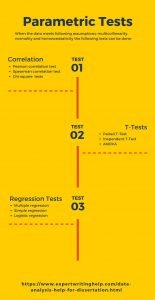
Here’s a little general advice on picking statistical tests. If your data is “normally distributed,” it’s best to use parametric tests. But if your data isn’t normally distributed (“non-normal” data), you should go with non-parametric tests.

9 Common Statistical Tests and How to Pick the Right One

Before you pick any particular statistical test, ask yourself: what do I want to do with my data? What do I want to know? After that, pick the statistical test that’s designed specifically to support the execution of that action.

Here’s a list of common statistical tests and what they’re best for so you can pick the best bet for your analysis.

Sign tests

Use the sign statistical test to study the difference between two related variables. This statistical test pays little attention to the magnitude of change in the difference (if any). However, the test factors in the direction of the difference between the variables in question.

Wilcoxon rank sum test

The test focuses on the difference between two variables that are independent of each other. It takes into consideration both the direction and magnitude of the difference between the variables.

Wilcoxon sign rank test

The Wilcoxon sign rank test is used to test the difference between two related variables.

ANOVA

This statistical test helps data analysts to test the difference between group means. Note: You shouldn’t run ANOVA before you’ve accounted for all variances in the outcome variable.

Paired T-test

The Paired T-test helps analyze the difference between the means of two related variables.

Independent T-test

The Independent T-test is the exact opposite of the Paired T-test. This test deepens the analyst’s understanding of the difference between the means of two independent variables.

Pearson correlation test

The Pearson test is a correlational statistical test. It enables you to accurately determine if any statistical association exists between two continuous variables.

Spearman correlation Test

The test is similar to the Pearson correlation test in that it’s a correlational statistical test. The test helps you to describe the association existing between two ordinal variables.

Chi-Square test

The Chi-Square test measures the strength of the association that exists between two categorical variables.

Multiple regression test

The test tracks how change in multiple predictor variables (2 or more) predicts change in the outcome variable.

Single regression test

The test tracks how change in one variable (predictor variable) predicts change in another variable (outcome variable).

You now know what each of 11 common statistical tests measure. At this point, picking the right test for your study should be pretty easy.

Statistical Tests For Inferential Analysis

You’ve learned what various statistical tests do. Which means you can easily know how to choose statistical tests that are suitable for your research. But you probably haven’t mastered any of the tests, have you? Obviously, you can’t leverage the power of any of the statistical tests if you don’t know how they work. Also, you should learn how to use statistical analysis software packages such as SPSS and MATLAB work. That’s because statistical tests and statistical software work hand in hand.

Infographic on how to choose statistical tests

how to choose statistical tests

Source: https://www.minds.com/media/939916680893247488

Video on how to choose statistical tests

Source: https://youtu.be/rulIUAN0U3w

Sample Essay: Early Industrial Revolution

The Significance of the Early Industrial Revolution

sample essay on industrial revolutionEarly Industrial Revolution or Pre-Industrial Revolution refers to the period before the advent of the Industrial Revolution. The period between 1500s and 1750s marked a shift in the foregoing level of selling and buying goods. The impetuous existing art forms and production of goods were brought to polarity in this era. The voyages from Western Europe led the way for the Revolution. The chief trade practices included trading in precious metals, handicrafts, cotton, etc. The farmers and merchants wanted to raise money by increasing trade with other nations. This led to the expansion of economy through fostering development in the involved nations. It is crucial to understand the genesis of the Early Industrial Revolution, which emerged through several centuries stimulating growth in the West and the rest of the world (Persson, p. 3, par. 2).

During the period of Early Industrial Revolution, there were no machines for equipping the making of goods. The manual labor was used for performing tasks and assembling units for the finished goods. During this era, textiles and other products were made at home, and people would trade their goods. Due to inadequate transportation and communication systems, the trading of goods was not possible on a large scale. Then the Europeans sought their way toward innovation and technology, which made their demands and market clearly available to the mass population. This paper discusses the significance of the Early Industrial Revolution, and the developments and innovations, such as Renaissance warfare, boatswain’s pipe, astrolabe, quadrant, and spinning wheel in addition to the roots of Industrial Revolution, the expansion of markets in the Pre-Industrial era, the European Cities, the cottage industry, the upswing trend in agricultural practices, and the innovation approach paving the way to the Industrial Revolution.

Under this section, the paper discusses the roots of Industrial Revolution in Pre-Industrial society, the expansion of markets in 1550s, the European Cities in the Pre-Industrial Society, the Renaissance warfare and other innovations in navigation and sailing apparatus, the rise in standard of living through urban set ups, the upswing trend in agricultural practices, the role of small scale industries in 1500s, such as cottage industries, and Pre-Industrial financial innovations, which led to a greater Industrial Revolution from 1750 onwards.

The Roots of Industrial Revolution in Pre-Industrial Society

The Early Industrial Revolution connoted a slow lifestyle with limited resources. During the 16th century, there were no manufactured goods; instead, there were various raw materials available in the rural areas. The wood was used to carry the domestic activities, and wind and water were the determining factors for the source of power. The basic source of income for the people of the Early Industrial Revolution in the 16th century merely came from farming, cow-raising, selling milk, etc. The Early Industrial Revolution also saw no substantial increase in population for decades (Tucker, par. 2). The common people grew in the fear of epidemics, such as Typhoid, Influenza, Plague, etc. These diseases resulted in mass dying due to insufficient care and medical facilities (“Pre-Industrial Society,” par.3).

Expansion of Markets in 1550s

history essay writing serviceThe Early Industrial Revolution has its significance in promoting and establishing strong foundation for the Industrial Revolution. During the 1550s, there was no existence of commercial industries. The small scale trade practices were emphasized from the households and agricultural lands. The craftsmanship was used to balance the lifestyle, for example, by making furniture, handicrafts, pottery, masonry, etc. (“Pre-Industrial Society,” par.8). The home-based occupations, such as weaving cloth and making dresses out of this cloth material were part of fine craftsmanship in the Early Industrial Revolution. The labor worked hard to complete their day-to-day tasks, but the production was very slow because of few tools and equipments. Some cities became centers for providing basic raw materials and goods. Markets developed for selling agricultural goods, handicrafts, and pottery items. During the Early Industrial Revolution, the elite people owned large areas of land and hired labor for growing agricultural produce, and also assigned work to the servants to help them carry out their daily activities. On the contrary, the poor people made goods from the raw materials and managed their lifestyle with minimal agricultural produce from small lands and cow-raising.

European Cities in the Pre-Industrial Society

Many cities flourished during the Early Industrial Revolution era due to their establishment of markets. The main attraction that accounted for the growth of a town into a city was the spread of its market. Florence, a prominent European city attracted traders, as it proffered handicrafts and several mechanically tinkered clay pots, kettles and pans (“Pre-Industrial Society,” par. 9). The Early Industrial Revolution era witnessed advancement in the European cities that were producing gun-powder and cannons through their basic industries with no thoroughly equipped tools.

Renaissance Warfare and other Innovations in Navigation and Sailing Equipment

In the 16th century, no democracy existed on the world map. There were rulers, ruling their dynasties and trying to expand their empires in order to gain more and more power. Through army and cavalry, with renaissance warfare, the rulers attacked the other empires. The use of war hammers, swords, clubs and maces, winged spears, lances, pikes, etc. as tools for warfare adds to the innovation list during the Early Industrial Revolution. The use of mechanical clocks and navigation tools, such as boatswain’s pipe, astrolabe, quadrant, and sandglass marked the beginning of 16th century (“Pre-Industrial Society,” par.9). These major inventions came up in navigation and sailing equipment.

Rise in Standard of Living through Urban Establishments

The increase in agricultural produce helped in feeding the population and to prevent health degradation, which formerly occurred due to shortage of food in the 15th century (“Pre-Industrial Society,” par.4). A wider view of competition was created among the people. They began working more in order to get more wages and have a better livelihood. They uplifted from the previous concept of living in the rural areas to better townships. They adapted to better living conditions and went to learning centers to get education about basic skills, which would be helpful in their survival to some extent, thus, moving toward urbanization.

An Upswing Trend in Agricultural Practices

One of the few very important reforms was observed during the Early Industrial Revolution, which was about the change in agricultural practices and patterns. The food production in Europe increased to a great extent in the future period as a result of persistent endeavors of the farmers and traders of the Early Industrial Revolution. In the mid 1500s, the demand for most of the products, such as textiles, warfare, cotton, etc. increased (Brock, p. 5, par. 3). Later on, in 1750-1800s, the historians called this reformatory era as the Agricultural Revolution (“Pre-Industrial Society,” par.15).

The Role of Small Scale Industries in 1500s

After 1500, the European markets expanded from Asia to the American continent. Europeans established industries and markets in other nations as well (McDowall, par. 3). The aim of such establishment was the expansion of their markets to extract more revenue out of other nations. The financial industry and cottage industry of Europeans also expanded tremendously. The Dutch East India Company expanded its market in order to derive spices from the South-East Asian countries (“Pre-Industrial Society,” par.11).

Cottage Industry in the Early 16th Century

Cottage industries were also seen as a peculiarly expanding market. The poor families depended on agricultural land, worked night long by weaving cloth with fusty machines, such as old spinning wheel in their cottages. The merchants who traveled in the countryside, in search of great deals, bought the fancy spun cloth from the small markets of cottage industries. Sometimes these merchants would also provide raw materials, such as cotton or wool, and paid them for the labor, and then took the finished goods to sell them further (“Pre-Industrial Society,” par. 14). This is how the cottage industry allowed the growth of industries in the Early Industrial Revolution era.

Pre-Industrial Innovations of 16th Century Leading to a Greater Industrial Revolution from 1750 onwards

Several innovations in banking and financial sectors laid the foundation for the following Industrial Revolution. The growth of traders and consumers of the 16th century, later on, attributed to the Industrial Revolution from 1750 onwards. Beginning from 1500, the trade expanded globally by transportation via boats and ships. The navigation instruments helped to increase the market and to discover nations. By 1600s, the Europeans living in the cities got interested in the markets and global trade opportunities by investing in financial innovations, and became difficult to dissolute the urban culture from them (“Pre-Industrial Society,” par.13). They wanted to expand the production and trade deals through the use of coal and textiles. These two raw materials i.e. coal and textiles gave a kick-start to the Early Industrial Revolution. In the 1700s, coke was widely used in the production of iron; also, several textile centers were established, and the construction of roads and canals was done. This made the country ahead in many inventions, and coal being a pivotal material, for example, it was widely used in operating the steam engine. In order to meet the needs of the families and the society, it motivated the traders and producers of the Early Industrial Revolution to think of strategies to manufacture goods on a large scale. Various reforms in the agricultural field, such as Crop Rotation, was invented by the Dutch (“Pre-Industrial Society,” par.16) Thus, the European markets expanded in numerous countries, and this paved the way for the Industrial Revolution.

Conclusion

Hence, the paper discussed the significance of the Early Industrial Revolution along with developments and innovations, which eventually provided the path to the greater Industrial Revolution. The Early Industrial Revolution emerged before the Industrial Revolution and laid the roots for the latter one. The beginning of the Early Industrial Revolution dates back to 1500s. The Early Industrial Revolution is said to be a domicile of Britain. It started in Britain and then expanded to the faraway lands. The small scale industries transformed into large scale after the developments in the field of technology. The use of wood, as a fuel, in everyday lives was replaced by coal. A few cities, such as Florence emerged as the prime centers of raw materials and goods. All these cities were patronized by the European merchants who traveled the countryside for varying trade purposes. The use of several renaissance warfare and innovations in this field is responsible for early developments in the Western Civilization. The other innovations included the sandglass, quarter, boatswain’s pipe, and astrolabe, which were also important instruments for navigation and sailing. The arrival of new technologies after the Early Industrial Revolution owes its credit to the zeal of the people from the Early Industrial Revolution era who wanted to bring reforms in their lifestyle, farming practices, and production methods to eventually fetch more profit through sale of their merchandise to other nations across the seas.

Works Cited

Brock, F. “How Pre-Industrial Era English and Dutch Trade Influenced Social Change,”

University of Massachusetts, https://www1.umassd.edu/euro/2007papers/brock.pdf. Accessed 17 April 2018.

McDowall, C. “World Textile Trade 1500-1800 – Pre-Industrial Revolution,” The Culture

Concept Circle, 31 January 2014. https://www.thecultureconcept.com/world-textile-trade-1500-1800-pre-industrial-revolution. Accessed 17 April 2018.

Persson, K.G. “A New Economic History of Pre-industrial Europe,” University of Copenhagen,

https://www.econ.ku.dk/kgp/doc/Workfrms/new%20econ%20hist.pdf. Accessed 17 April 2018.

“Pre-Industrial Society.” Bellarmine College Preparatory,

https://webs.bcp.org/sites/vcleary/modernworldhistorytextbook/industrialrevolution/preindus.html. Accessed 17 April 2018.

Tucker, G.S.L. “English Pre-Industrial Population Trends,” The Economic History Review, vol.

16, no. 2, https://onlinelibrary.wiley.com/doi/pdf/10.1111/j.1468-0289.1963.tb01726.x. Accessed 17 April 2018.

Buy History Papers On Industrial Revolution from Professional history paper writers

Are you in need of history paper writing service from expert writers. We at Expert Writing Help assist students write essays, research papers, capstone projects, dissertations and thesis papers on history.

How To Write APA Literature Review

How To Write APA Literature Review

how to write APA literature reviewAre you a student writing your dissertation, thesis or capstone project? then learning how to write APA literature review is a must. APA style of literature is one of the most appreciated and one that has been taken up vastly into the curriculum. Many dissertation papers and other quality writings have taken up this form of writing. It has been found to be quite presentable and comprehensive in that it covers all the details and also that it gives references. I wouldn’t think of a better format of writing that ensures such a good flow of idea and a continuity of thoughts than APA style of writing. This will be one of the most informative articles as it would probably be the reason that you get those extra marks in your dissertation paper. I will be showing you how to get in the flow with APA style in literature.

Guidelines: How To Write APA Literature Review

Writing style

You are to make sure that you familiarize yourself with the basic writing styles there is and given that they actually include tonal variation and approach you should use a formal kind of tone in your piece. This will be able to communicate a level of professionalism and it reassures the reader that you really know what you were into. It also helps in the event that it is to be put up for a presentation; it can never go wrong with any kind of audience.  Basically, you need to make sure that you use a formal tone and that you are unbiased.

Formatting

The other thing that can easily pull you down and dismiss your piece from being in an APA style to any other style is the formatting; by formatting, I mean what the outlook is basically made of. You will want to consider factors such as font type, size, spacing, title page, and even the margins. You have to be precise and realize that using a font of 11 is not the same as using a 12 font. You should write your piece in Times New Romans and make sure that the font size is up to 12, not higher, not less. Having a comprehensive understanding of the APA formatting style could easily take your piece from being a 7 to a 9. You will realize that when you combine ideas and a good format, you get a complete piece. But when you just have the ideas you will be missing something.

In-text citation

This covers all things content and what is engulfed in your piece. Hear me out on this, I don’t really mean that you reinvent the wheel but you need to bring some originality in your work. You have to make sure that your work is plagiarism free and it is fresh. That can only be as a result of vast research and getting content that is quite reliable. You might need to get a couple of sources to match and after you get a trend you can now fixate on one piece that seems to be quite comprehensive. However, have in mind that if you decide to pick something from a piece that you show that by bringing in the opening and closing inverted commas and stating out from where it came from. However, this too has to be done professionally. You have to state the date, month then the year or vice-versa and give credit where it is due by giving a name.

Reference

literature review outlineThis will normally come at the end of your article where you will give credit where it is due by citing out the sources of your research and how much it impacted your writing. It is usually not a random way of doing it as it also has a legal kind of aspect to it where it protects content researched and produced by others. Take for instance, what would you do if you found someone else out there using your work and getting a credit on it without even acknowledging you? It would be very hurtful and you may decide to take legal action. However, it is also for credibility purposes. This is because, some of the material that people use, are well-known pieces from people such as Sir Newton, Shakespeare, and the other legends that when you try using as your work will question your credibility. After all, you don’t want to be a copycat and a quack.


In the event of a literature review, you will need to fixate on a certain piece of work that you will be working on. In your article, you will have to have a thesis that you will stand behind all the way to the end. You will also find it quite useful if in some fields if you take an approach of using a hypothesis. In this way, you can take a swaying vote to either bring on some more exciting facts that might have been omitted or you can raise an argument against that. This will also mean that while giving your reference you will have to state what you are backing up or going against. This is quite an open field and according to your research or opinion, you can take a side.

Unlike other forms of writing, the APA style of writing seems to be the most appreciated especially by the department of sciences and also the literature department. As a student of sciences and literature you will need to learn how to write APA literature review to get maximum point. The similarity between these two fields being that they are both technical and that they need a high level of professionalism to pass on their ideas without breaking the thought and maintaining the flow. I am by now convinced that the best article means the article with good flow and a comprehensive pack of ideas.

To get a good grasp on this you will need to take your time and study other pieces that have adopted that kind of writing. You should also try converting some of your pieces into this format and practice more and more on this. You will be a pro in this within no time. As a matter of fact, a study from one of the world’s leading universities has shown that in the next couple of years this style will have been integrated into every other field.

Buy Literature Review From Experts Who Know How To Write APA Literature Review

During your college and university learning you will be required to write research papers, dissertation, thesis or capstone project paper. A literature review is a must write section in any of these papers. In case you’re yet to muster how to write APA literature review you will be have to hire a literature review writer. Don’t worry!! most students pay literature review helper due to tight schedules and lack of effective writing skills. At expertwritinghelp.com we assist students write all types of literature reviews that include:

  • Argumentative review
  • Integrative review
  • Historical review
  • Methodological review
  • Systematic review
  • Theoretical review

Learning how to write APA literature review is critical if you’re to become a researcher. It is imperative to follow our guide to muster basics of literature review writing.

How to Write Nursing Care Plans

How to Write Nursing Care Plans

how to write nursing care plansNursing care plans are unavoidable in nursing school and nursing workplaces. That’s why you must learn how to write nursing care plans. Your professor needs detailed nursing care plans. They want you to learn how to process information and think like a professional nurse. That explains why your teacher wants you to write nursing assignments all of the time. You’ll write nursing care plans, whether the class is community care or mental health. Learning how to write nursing care plans is critically important for anyone who wants to become a nurse.

What are Nursing Care Plans and Why Do They Matter?

Why learn how to write nursing care plans, evidence based practice papers among other health care paper plans? Nursing care plans are written documents or medical records that form an integral part of the nursing process. Different places may use slightly different formats, but the final document achieves the same aims in every place. Nursing care plans guide how nurses provide nursing care to patients. The documents help nurses working different shifts know the exact actions other nurses have taken for each patient. These records are a consistently reliable way of organizing and communicating the actions of everyone involved in patient care. Specifically, nursing care plans document assessment, diagnoses, planned interventions, and evaluation. Each aspect is a precise process that nurses handle with ease. Once you learn how to write nursing care plans, your confidence will increase. And you’ll likely see better grades.

The 5 Steps That Lead to Well-developed Nursing Care Plans

Nursing care plans do not follow the exact same format in every place. That said, the following five steps should give you a document that satisfies your professor. Here are the steps on how to write nursing care plans: Assessment, Diagnosis, Planning, Implementation/Nursing Orders, and Evaluation. Let’s consider each step and see how each contributes to the final document.

Step 1: Write the Assessment Section of Your Care Plan

nursing assignment writing serviceWhile preparing a care plan, assessment is the first step of the process. As you fill out this part of the template, there are a few critical questions you need to answer. Why is the patient here? Why are they seeking care? What’s the patient’s general appearance?  You need to be able to do an accurate and comprehensive assessment. Assessment is about collecting and recording different kinds of data.


According to the American Nurses Association, you should gather physiological, economic, sociocultural, and spiritual data. You should also capture lifestyle information. Assessment seeks to understand the physical causes of pain, how the pain manifests itself, and how the patient responds. Your assessment may look like this: Anger directed at family and hospital staff, refusal to eat, request for pain mediation. Maybe your patient’s skin is cold and clammy. The assessment section should be brief, just like every other section included in a well-written nursing care plan.

Step 2: Fill Out the Diagnoses Part of the Care Plan Template

The diagnoses part focuses on the “What” of the patient’s condition. Here, you’re trying to answer this question: “What’s the patient’s problem?” The information recorded in this section helps nurses determine the care the patient will receive. The diagnoses part of a nursing care plan lists the conditions and health problems a patient is facing.It aims to develop a nursing diagnosis statement.

4 Types of Nursing Diagnosis

North American Nursing Diagnosis Organization-International classifies nursing diagnoses into four categories. Here they are: Actual diagnosis, Risk diagnosis, Health Promotion diagnosis, and Syndrome diagnosis. Each type of diagnosis can lead to an effective diagnosis statement, which is the main aim of the diagnosis section. Each diagnosis statement has three parts. The first part is the problem statement or diagnostic label. For example, the problem may be nausea or anxiety. The second part is the “related to” or RT part. This part focuses on the cause of the problem. The third part presents the defining characteristics. Defining characteristics, usually expressed as “…as evidenced by…” means the signs or symptoms that support your diagnosis.

Actual Diagnosis

According to NANDA-I, an actual diagnosis makes a clinical judgment about how a patient experiences or responds to health conditions or life processes. Actual diagnoses are existing problems that a nurse can identify. These conditions and life processes may exist in the patient, their family, or community. Here’s an example of an actual nursing diagnosis: Ineffective airway clearance. Or, spiritual distress. Another example: Sleep Deprivation.

Risk Diagnosis

A risk diagnosis describes human responses to life processes or health problems that may develop in an individual, family, or community. Here, the family, individual, or community isn’t facing any condition, but they remain vulnerable.  Certain risk factors may increase vulnerability for different conditions. Risk diagnoses are health problems, conditions or situations that do not currently exist but which may occur. For example: Risk for shock.

Health Promotion Diagnosis

This diagnosis refers to a clinical judgment regarding the motivation or desire of an individual, family, or community to increase wellbeing. It’s also about the desire or motivation to “actualize human health potential,” according to NANDA-I. That desire or motivation gets expressed as a readiness for specific health behavior(s).NANDA-I further states that a health promotion diagnosis statement normally starts with the phrase “Expresses desire to enhance….” For example: Expresses desire to enhance nutrition.

Syndrome Diagnosis

A syndrome diagnosis is a clinical judgment that describes a particular cluster of nursing diagnoses that normally occur together. Such diagnoses typically get addressed together and require similar interventions. While writing this diagnosis, you must use at least two diagnoses as defining characteristics. For example: relocation stress syndrome.

Here’s how you would write a complete nursing diagnosis statement for your assignment:

Ineffective Airway Clearance: Diagnostic label

Ineffective Airway Clearance RT fatigue: “related to”

Complete statement: Ineffective Airway Clearance RT fatigue as evidenced by dyspnea at rest.

Note: The “related to” and “as evidenced by..” parts are important when you’re writing nursing school assignments.  However, they are not always necessary in nursing workplaces where nurses use computers to prepare care plans. One more thing: keep the nursing diagnosis book recommended by your school handy. It promotes accuracy and makes writing diagnoses somewhat easier.

A Nursing Diagnosis is Different than a Medical Diagnosis: Write the Right Diagnosis

Don’t confuse a nursing diagnosis with a medical diagnosis. North American Nursing Diagnosis Organization-International (NANDA-I) clarifies the difference between a nursing diagnosis and a medical diagnosis. According to NANDA-I, a nursing diagnosis describes a patient’s responses to actual health problems or potential health problems. In contrast, a medical diagnosis defines an injury or disease process. Only a doctor can write a medical diagnosis. So, avoid listing down diagnoses such as “Diabetes,” or “Heart disease,” or Cancer.” Based on a nursing diagnosis, a nurse can easily select an effective intervention method.

Step 3: Write the Planning Part of Your Nursing Care Plan

At this point, you need to set specific, measurable, and achievable goals that guide care for the patient. You need to decide what short-range goals and long-range goals the patient’s care will pursue. So, what goals do you want to set for the patient? Suppose you have an immobilized patient. You may set a goal suchasPatient will move from bed to chair 3 times per day. Another goal might be: Patient will tolerate clear liquids within 18 hours without vomiting and nausea. Or, Patient will be pain-free within 3 hours. Let’s write down one more goal: Patient will report decreased nausea within 12 hours. The goals are clear and measurable, and everyone involved knows what each goal means.

Step 4: Complete the Implementation/Interventions Part

The Interventions part focuses on helping the patient and care providers achieve expected outcomes. Each patient’s record reveals the specific actions nurses need to take. So, write down the actual actions that require attention, including how often and how long. For example: Nurse to assess patient’s nausea every 6 hours. Example 2: Nurse will administer pain medication as ordered or needed.

Step 5: Finally, Evaluate the Nursing Care Plan; Decide if the Plan Needs Modification

Nurses must keep evaluating their patients’ wellness or health status. They also need to keep evaluating the effectiveness of the nursing care provided. The evaluation section carefully considers each goal set for the patient. For this section, a goal was either “Met” or “Unmet.” What if a goal gets “unmet?” You may need to revisit the diagnosis step. You may also modify the goals or add interventions.

Nursing Rationales: Not Always Included but Your Professor May Ask You to Include it

Your professor may ask you to include a nursing rationale in your nursing care plan. Nursing rationales can be confusing, and writing them may give you problems. You’ll understand rationales best if you can see how they interact with nursing diagnoses, care goals, and interventions. Basically, a rationale explains why a nurse set a particular goal or chose a specific intervention. Every nursing intervention needs a nursing rationale. Here’s an example of how you might write a nursing rationale:

Pain control will help the patient improve their life by enabling them participate in physical therapy exercises.

Final Remarks on How to Write Nursing Care Plans

Writing nursing care plans can be quite confusing. Nursing students may not always clearly understand the differences between the various elements of a care plan. It’s easy to confuse “Planning” and “interventions,” for example. Also, some students may not know how nursing diagnoses differ from medical diagnoses. One more thing: your instructor decides the specific format you should follow for your nursing assignment. Hopefully, this post has described each part of a nursing care plan clearly and helpfully.

Nursing Care Plan Writing Service For Nursing Students

Are you a nursing student looking for a professional nurse to handle your nursing care plan assignment? We at https://www.expertwritinghelp.com provide students in United States of America, Canada, UAE, Australia and United Kingdom with nursing care plan writing services at affordable costs. NCP is an integral document in delivery of effective nursing care and achievement of desired patient outcome. The plan details actions, interventions and care that a patient receives in his treatment process. Therefore, a nursing care plan should be unique and individualized according to patient needs. Our nursing writers are well knowledgeable and equipped with how to write nursing care plans for different diagnosis, making us the best nursing writing website to seek nursing care plan writing help.

See video below on nursing care plan tutorial.

Writing Evidence Based Practice Papers in Nursing

How To Write Evidence Based Practice Papers in Nursing

evidence based practice papers in nursing Are you a nursing student looking for information on how to write evidence based practice papers? the reason why it is important to base our nursing care on evidence based research is to enhance nursing care delivery services, improve patient outcome and also assist other agencies enhance health care delivery through published interventions.

Since back in the day, the medical field has been one of the most crucial fields in the society. Quality assurance is of very high value as this can draw the thin line between life and death. However this does not all start in the hospital as a head nurse or doctor but rather it starts right from nursing school. Evidence based practice papers are simply written to prove a certain hypothesis that is at hand. Are you trying to reinvent the wheel? No! But rather just trying to modify it.

These papers are important as they help keep up with trends, save cost, evaluate projected outcome and to do away with methods that are quite outdated. An evidence based practice contains a couple of sections and are basically written with the same formatting as essays, but with a bit of a twist that I will take you through. At the end of this trust me you’ll be a pro at it.

Guidelines of Writing Evidence Based Practice Paper

Title

Right down from the basics you will need a title for your evidence based practice. This is majorly to guide you on what you are to write and it creates the basis for your hypothesis. Your title should be quite brief and pinpoint clearly what your evaluation will be on. Your tile can take a couple of forms as well. It can take the form of a question, a simple statement or an opposing fact. This way you will have set the direction right from the start and you will give the reader something to anticipate at the end of it. Simply think of it as a pacesetter.

Establish your thesis

A thesis is basically the controlling statement that you are standing with. Have in mind that a thesis is different from a hypothesis in that: a hypothesis is an idea that you can either prove or put claims against it. However a thesis is basically what you stand for and it gives the agenda that you will be pushing all through. Any evidence based practice without a thesis is a considered an incomplete paper as it leaves a lot to guesswork and imagination.

Read our article on how to write nursing capstone project papers to understand what makes a strong thesis statement.

Good formatting

The format of your nursing essay paper is basically the eye catcher and it snatches the attention of your reader. It is always good to maintain a certain level of professionalism even as you write your paper. The best formatting to go for at this juncture is the APA formatting. You will find out that when you have mastered this formatting then all you need to take care of is the content and the rest will flow. Basically, the APA formatting is the kind of formatting used in social sciences and it gives a continuous flow of ideas which explains its dominance. It is divided into four main sections that are;

  1. Title- This hints what they appear is all about and gives the reader the direction to take and what facts to use during their evaluation.
  2. Abstract- This is the basis of your thesis and your try explaining it in not more than 250 words and not less than 150 words. Let your reader know that you really know what you are talking about
  3. Main body- This is the ‘flesh’ of your paper as it contains all the facts, figures and arguments placed. This is the platform that you have to put all your ideas and arguments all together to boost your thesis.
  4. References- Many who have had their papers rejected will tell you that they lacked this part of the paper. This is where you let your reader know from where you sourced this information. But first hold that thought, I will be expounding it in a few.

Research

research in nursing careThe quality of your work will be determined by the amount of research you carry out. In this field, as you might well know half a dosage is not the same as a full dose. A 1*2 prescription is not similar to 2*1. Despite the fact that they add up mathematically they don’t add up medically. You have to get current references and make sure that in the event that you decide to quote something that you indicate from where it is lifted from.

After all, you do want to produce fresh content. This is simply a process that you will follow; the title gives birth to your thesis, your thesis brings about research, research produces evidence and evidence will ultimately give the evidence based paper you are looking for. The one thing that you need to realize is that you are not limited to the number of contexts that you can research from. You can simply cover a wide scope for more credibility. Also, make sure that you get your facts right. As you write your evidence based practice paper in nursing, have in mind that the quality of your work is directly proportional to the quantity of your research.

References

Getting back to this as earlier promised; references take the guesswork out of your paper. They are the surest indication of research and they get even better when you can link them up together. You can get an inter-relation between your references and this strengthens your paper even the more. Despite the fact that you are just proving your hypothesis, you can make an original piece from other peoples work. The way to do this is getting creative and where you borrow their ideas make sure that you give them the credit they deserve. That way you will have put your best foot forward as far as evidence based practice papers are concerned.

Another very important thing to put in mind is that you should always describe your methods. On this, you should be very keen as your credibility is at stake here. You should ascertain that all measurements, figures, interviews, observations, and surveys are taken with precision and are transferred correctly. Do this and trust me you will have anchored yourself properly as far as your paper is concerned. Get the right material, formatting and ensure precision in everything and you’ll be good to go.

Where To Buy Evidence Based Papers in Nursing

Are you a nursing student looking for the best nursing paper writing service online?  our team of writers are well versed with different nursing papers.  We are experts in writing DNP projects, essays, research papers among others.


Better Schooling: Australian and British Education Systems?

Comparison between Australian and British Education Systems

UK education systemsAustralia and the United Kingdom are both English-speaking countries. Are you a teacher or student looking to join the education systems in either country? Understanding how each education systems works would help you settle quickly and start working toward your goals. The two systems differ in certain aspects, and it is in your interest to know what those differences are. This comparison between Australian and British education systems hopefully provides information you would find helpful.The comparison touches on areas such as costs, examinations, regulation, funding as well as higher education.

Australia Boasts Eight Different Systems of Education

The Australian government, a federal system, has the primary responsibility for education. The country’s population is smaller than that of the U.K. Can you believe Australia boasts of eight different education systems? What’s more, each system sets its own high school leaving exams. Being a registered teacher in one state does not automatically qualify you to teach in a different one. If you wish to move to another state, you will need to register with them.

Increasingly GCSE-focused U.K. Education

The U.K. has made significant changes to the GCSE examinations.These changes started with Michael Gove, a former education secretary in England. The new GCSE is similar to the O-levels of pre-1988 U.K. The new move hopes to address what Gove called the “dumbing down” of the curriculum and grade inflation. The new exams are supposed to be more challenging than GCSE has ever been.

Australia does not have a GCSE equivalent, and no one body sets the country’s education agenda. However, the U.K. seems to be gravitating — albeit unconsciously — toward a federal style system similar to that in Australia. That said, there will always be country-specific differences that set each country’s system apart from those in other jurisdictions.

Types of Schools in Australia

Australian schools aim to provide a well-rounded education that prepares students for life after school. Their education systems covers key learning areas including math, English, arts and science, languages, society and environmental studies, and physical education. They also study technology and health education.

The types of schools found Down Under include government schools, non-government schools, and those based on educational philosophies. Non-government schools include faith-based schools such as Islamic or Catholic schools. Some of the educational philosophies guiding the establishment of schools are the well-known Montessori and Steiner. Every school in Australia needs to ensure registration with specific state’s education department.

Types of Schools in the U.K.

The four main types of school found in the U.K. are academies, maintained Schools, independent schools, and free schools.

Maintained Schools

Local authorities own and maintain these schools. Maintained schools have to adhere to all the requirements of the national curriculum. There are four types of maintained schools. These are foundation, trust, voluntary controlled, and voluntary aided schools.

Academies

Academies are state-funded.  That said, they exercise more independence than most other schools when it comes to directing their curriculum. They have the power to introduce faith-based topics or even change school hours. Sponsors from the business world, faith or voluntary groups work with the Department of Education to establish academies.

Free Schools

Funded by the government but not controlled by the local authority, free schools are like the academies. They can exercise some flexibility regarding term dates and the curriculum. Universities, community groups, parents, charities, or teachers usually establish these schools.

Independent schools

They are public or private schools run using fees paid by parents. They may also get support from various organizations.They can set their curriculum. To ensure independent schools maintain the required standards, the independent schools Inspectorate regularly inspects them.

Compulsory Education both Countries Proceeds Until the Age of 16

Just like in Australia, compulsory schooling in the U.K. starts at the age of five and continues until learners attain the age of 16. Except in one state, Tasmania, compulsory education in all states in Australia proceeds until children hit the age of 16. Compulsory education ends a year earlier in Tasmania, when learners are, often, 15.

Qualifications In Australia

Australian students strive to improve their Tertiary Admission rank — aka ATAR. The ATAR replaces by the year 2018 the Overall Position ranking currently applicable in Queensland. Queensland uses a system based on teachers’ assessments of students’ abilities. The ATAR is the main method that guides the selection of students for university programs.

Most of the programs offered at the universities usually set a minimum ATAR. Naturally, all year 12 students stress over their ATARs after they have sat the exams. Some experts have criticized the ATAR system arguing it forces learners to avoid or choose certain subjects to improve their score.  However, universities are increasingly adopting selection methods that do not consider a student’s ATAR only. Many expect the reliance on ATAR for selection of students for tertiary education to continue declining.

Qualifications In the U.K.

U.K. secondary school students focus on GCSE exams. They sit for these exams at the end of year 11. Traditionally, they have studied math, English, and science. Learners can also study the arts, humanities, technology, vocational studies or languages. Some may leave school at this point, but it certainly is not a good idea. The majority of students in the U.K. are preparing for the A-levels during years 12 and 13. Year 12 is also referred to as “lower sixth” while year 13 is commonly called “upper sixth.”

Diploma or Degree After GCSE exams

Also, a learner in either year 12 and 13 can be said to be a “sixth form” or “upper secondary” student. Successful upper secondary students can choose to join university or get a diploma. The diploma is a relatively new development in the U.K. The traditional path has always been proceeding to the university after the A-levels. In England and Wales, the law requires all kids aged 5 –16 to acquire at least primary and secondary school education.

School Terms

The academic year in the U.K. typically starts in September and ends in June or July of the following year. Each academic year has four school terms. Local education authorities in the U.K. are responsible for setting their holiday and term dates. The longest holiday break runs for five to six weeks. It is the summer school holiday when most people plan their travel.

In comparison, the Australian school year starts in early February and ends in November or early December. The term commencing date varies with states as well as whether the school is a government one or not. Earning an undergraduate degree Down Under takes 3–4 years. In comparison, it would take you 6 – 12 months less time to obtain the same degree in the United Kingdom. That means studying in the U.K. can allow you to enter the labor market a bit earlier.

Australian and U.K. Class Sizes

As a prospective student or teacher, you want to know how big classes are in Australia and U.K. Classes in the U.K. have a maximum of 30 students while 25 is the highest number of learners sitting in Australian classrooms. You may think being a teacher in the U.K. is a lot tougher than it would be Down Under. Class assistants working to support teachers in the U.K. make the slightly bigger classes there more manageable.

Tuition Costs

As a potential student, you would want to know how much it would cost to earn your degree in either country. In both countries, domestic students pay less than international or other students. And governments in both regions set a fees limit beyond which institutions cannot charge. Additionally, both countries provide subsidies and loans that make education more accessible than in most other places.

Tuition Costs In the UK.

How much you pay depends on the particular country. For instance, costs in the United Kingdom for Home students studying typical undergraduate degrees in English universities in the U.K. pay up to 9,250 pounds per year. Welsh institutions charge up to 9,000 pounds for home students. North Irish universities charge home students up to 5,220 pounds less than what England charges its home learners. It gets more interesting. Can you believe that home and European Union students pay ZERO for their undergraduate degrees in Scotland? However, learners from Wales, Northern Ireland, and England end up paying 9,250. International students spend even more.

A typical degree would, therefore, cost you between 0 – 27,750 pounds in the U.K. It would all depend on which country you chose and whether you are a local, EU, or international student.

Tuition Costs In Australia

Australian education systemsIn Australia, the costs can differ significantly across states. Institutions charge fees per unit rather than per year. A student can expect to study a cluster of courses, and each class belongs to a specific “band.” Australian universities offer subjects from different bands at different costs. That means students pay different amounts every year depending on what they are studying.

There are various similarities and differences between Australian and UK education systems. Developing a clear understanding of these differences and similarities can help you make informed decisions regarding preparation. Hopefully, you can now move forward with confidence.

However with the looming Brexit, we tuition costs in the United Kingdom to significantly change.

This post was researched, compiled and written by our MBA project writer in UK who has vast interests in educational maters. visit us at https://www.expertwritinghelp.com for dissertation and academic coaching services at affordable rates.